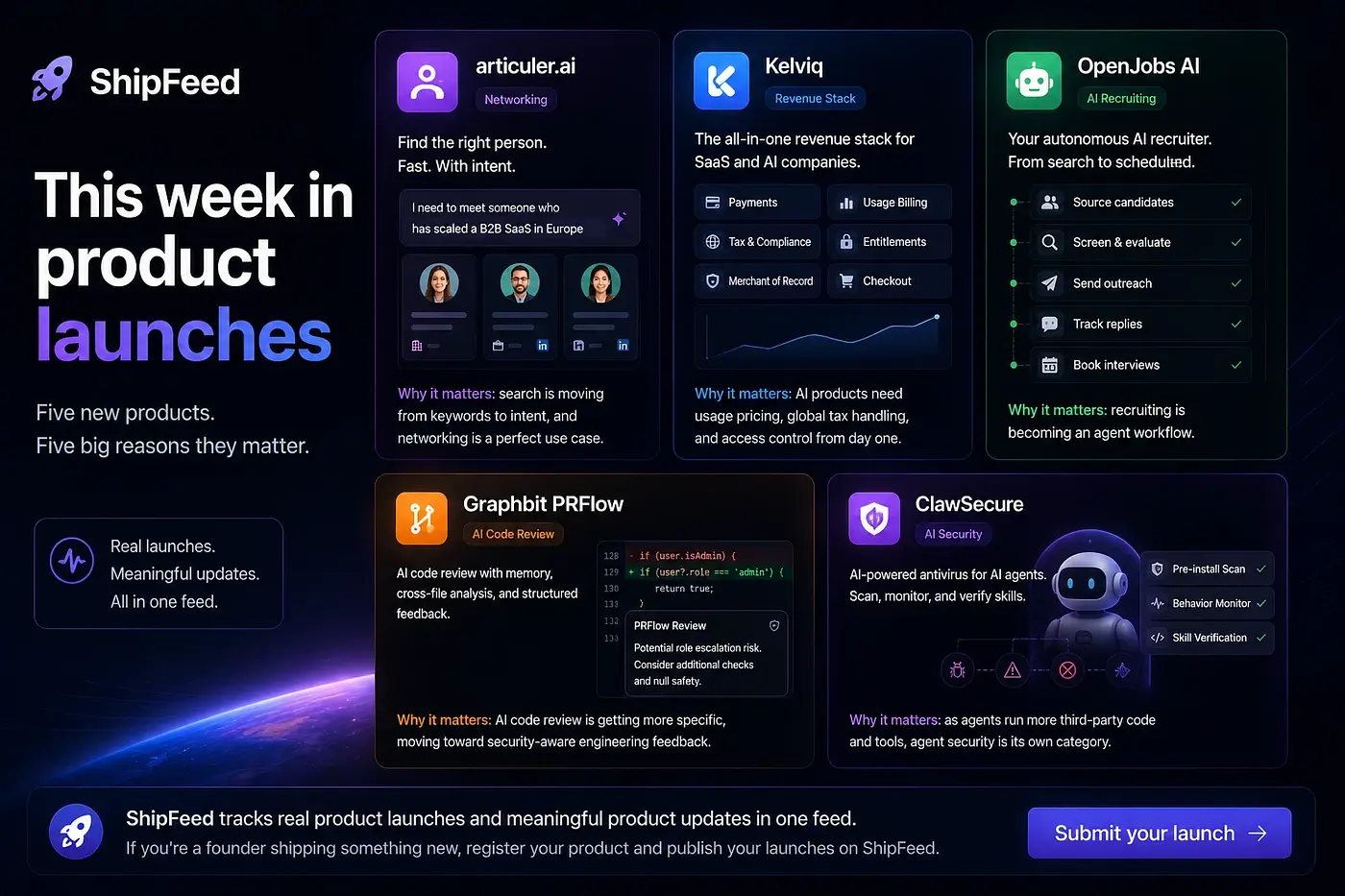
The software launches shipping in mid-May 2026 show how quickly AI products are moving beyond chat interfaces. This week’s strongest releases focus on the infrastructure around autonomous work: agent security, AI code review, recruiting automation, revenue operations, and intent-based professional networking.
Here are five AI agent tools and software launches worth understanding from the week ending May 17, 2026.
1. articuler.ai: intent-based professional networking
articuler.ai introduced a networking workflow built around intent rather than rigid filters. A user describes the person they need to meet, and the product returns relevant matches together with context and suggested outreach.
Why it matters: professional discovery is difficult when the right person cannot be described by job title, company size, or location alone. Intent-based search can capture the problem, experience, or relationship a user is actually looking for.
2. Kelviq: revenue infrastructure for SaaS and AI products
Kelviq launched a revenue stack combining payments, tax handling, merchant-of-record coverage, usage billing, entitlements, and checkout tools for SaaS and AI companies.
Why it matters: many AI products need usage-based pricing, global tax support, and product-access controls from the beginning. Bringing those systems together can reduce the amount of billing infrastructure an early team must build itself.
3. OpenJobs AI: autonomous recruiting workflows
OpenJobs AI shipped an autonomous recruiter designed to source candidates, screen profiles, send outreach, track responses, and book interviews.
Why it matters: recruiting software is shifting from passive applicant databases toward coordinated workflows. The useful question is no longer only who matches a role, but which repetitive steps an agent can complete while a human recruiter keeps control of the hiring decision.
4. Graphbit PRFlow: AI pull-request review with repository context
Graphbit PRFlow released an AI reviewer for GitHub pull requests with codebase memory, cross-file analysis, and structured review comments.
Why it matters: generic comments are not enough for production code. Review tools become more valuable when they understand relationships across files, retain project context, and focus attention on concrete engineering or security risks.
5. ClawSecure: security scanning for AI agents
ClawSecure launched security tooling for agent skills, including pre-install scanning, runtime monitoring, and verification controls.
Why it matters: agents increasingly execute third-party tools and code. That creates a distinct software-supply-chain problem: teams need to understand what a skill can access and detect suspicious behavior before and after installation.
What these AI launches have in common
Each product applies AI to a complete workflow rather than a single prompt. They manage context, coordinate steps, connect to existing systems, or monitor what autonomous software is allowed to do. That pattern is likely to define the next generation of useful agent products.
Browse more AI and machine learning products, explore other weekly software launch roundups, or visit the ShipFeed product directory to follow what software teams ship next.